What R-value is worth paying for when the garage is attached to a bedroom
Insulation in a garage door does three things: it slows heat moving through the panel, it makes the door substantially more rigid, and it makes it quieter. In this climate the first matters only sometimes, and the other two matter almost always.
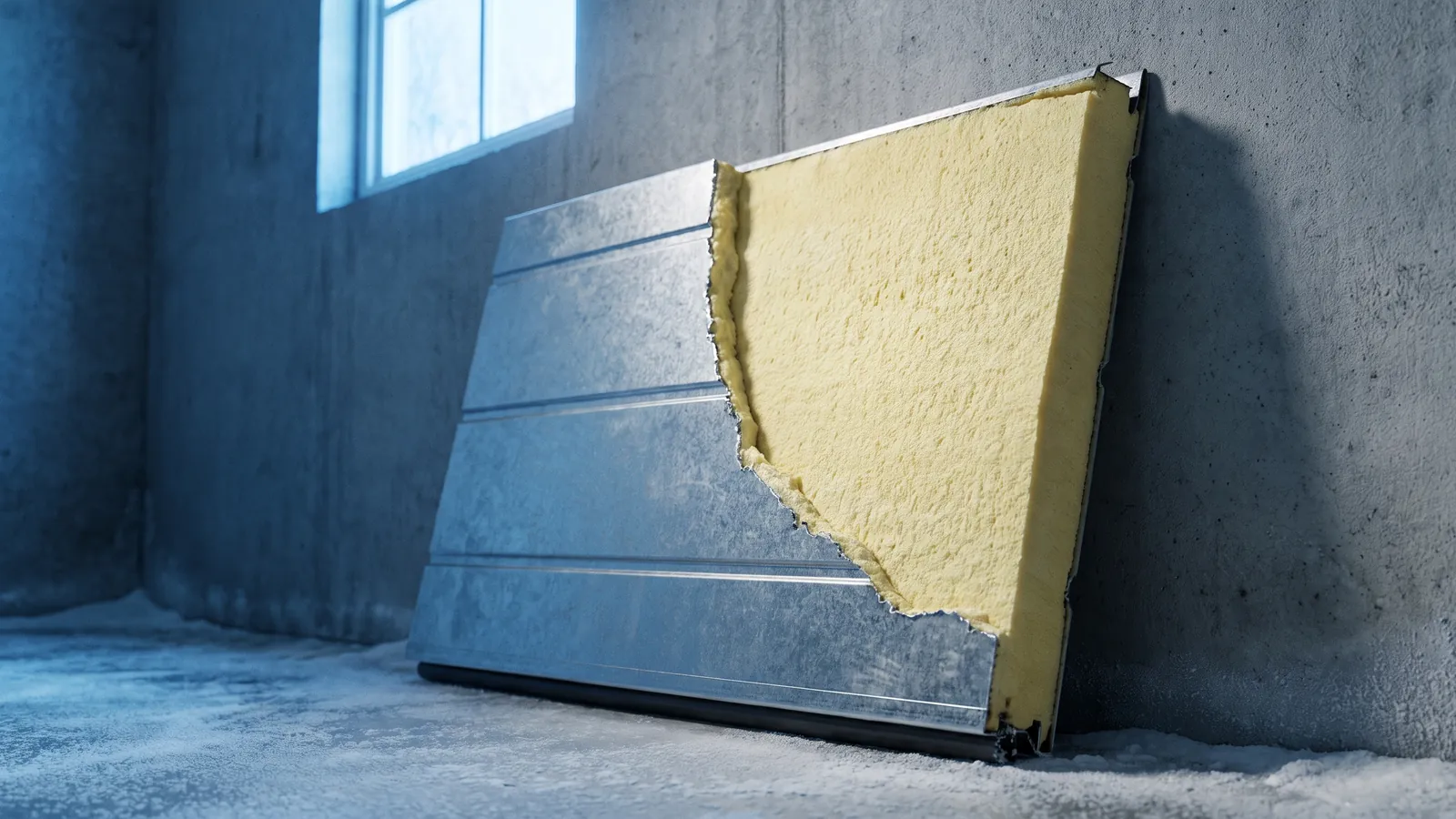
Start with whether it matters at all. If the garage is detached and unheated, an insulated door is buying you rigidity and quiet, not warmth, and the money may be better spent elsewhere. If the garage is attached, and especially if there is a bedroom above it or a room sharing a wall with it, insulation is doing real work — Kansas City runs from normal January lows around 20 degrees to proper summer heat, and the garage door is typically the largest uninsulated surface in the whole building envelope.
Polystyrene versus polyurethane. Polystyrene is rigid board cut to fit between the steel skins. It is cheaper, it insulates reasonably, and because it is only fitted rather than bonded it adds modest rigidity. Polyurethane is injected as a foam that expands and bonds to both skins, which gives a higher R-value for the same thickness and turns the panel into a far stiffer composite. For a door facing hail and twenty-mile-an-hour wind on an exposed elevation, that bonded rigidity is worth as much as the thermal number.
On R-values, be sceptical of the headline. Manufacturers quote the figure for the panel at its thickest point, not for the whole door, and the door is full of thermal bridges — the steel stiles, the sections where the panels meet, and the perimeter where it meets the frame. A door advertised at R-18 is not an R-18 wall. The useful comparison is between doors rather than against building insulation: R-6 to R-9 is a meaningful improvement over an uninsulated door, R-12 to R-18 is worth it on an attached garage you actively heat or use as a workshop, and beyond that the returns flatten.
What insulation does not fix. The gap under the door. A beautifully insulated panel with a hardened gasket and a half-inch of daylight beneath it is losing more through the gap than through the panel. Seals are cheap and should be done first or at the same time — see weather seals. The same goes for uninsulated walls between the garage and the house, and for the ceiling below a bedroom. The door is one part of a system, and it is the part people replace first because it is the visible one.
The weight consequence. An insulated door is heavier than the one it replaces, sometimes substantially. That means new springs sized to the new weight, and it means checking the opener is rated for it. Fitting a heavy insulated door to old springs and a tired opener is how people end up with a lovely new door that fails in two years.
What's included
Honest about where it pays
Attached garage with rooms above or beside it, yes. Detached and unheated, you are buying quiet and rigidity instead.
Polyurethane where it earns its place
Bonded foam for higher R-value in the same thickness and a far stiffer panel against hail and wind.
R-values explained properly
What the headline number covers and what it leaves out, so the comparison you make is between real doors.
Seals addressed at the same time
No point insulating a panel while leaving a half-inch gap under it; the gasket and threshold get sorted too.
Springs matched to the new weight
Insulated doors are heavier. New springs sized correctly, not the old pair carried over.
Opener capacity checked
If the existing opener is not rated for the heavier door, you hear that before the door is ordered.
Insulated garage doors prices on the Kansas side
| Job | Typical price | Notes |
|---|---|---|
| Single insulated steel, R-6 to R-9 | $1,350 – $1,900 | 9x7, polystyrene core |
| Single insulated, R-12 to R-18 | $1,600 – $2,200 | 9x7, bonded polyurethane |
| Double insulated, R-6 to R-9 | $1,850 – $2,500 | 16x7, polystyrene core |
| Double insulated, R-12 to R-18 | $2,200 – $3,100 | 16x7, bonded polyurethane |
| Carriage style, insulated | $2,400 – $4,200 | Overlay detail with a polyurethane core |
| Upgrade from polystyrene to polyurethane | Add $250 – $550 | Priced at the point of order |
| New springs for the heavier door | Included | Sized to the fitted door's measured weight |
| Full perimeter seal package | $260 – $470 | The other half of the job |
These are 2026 ranges for the Kansas side of the metro, to give you a figure to plan around. What you pay is agreed in the driveway before work starts, with parts and labour listed separately; new doors and openers get a written figure that holds for 30 days.
Recent work
Questions we get about insulated garage doors
What R-value do I actually need?
If the garage is attached but unheated, R-6 to R-9 is a sensible, cost-effective improvement. If there is a bedroom above it, or you heat the space, or you work in there through the winter, R-12 to R-18 earns its keep. Beyond R-18 the extra cost buys very little on a door that is still full of thermal bridges at the stiles and joints.
Polystyrene or polyurethane?
Polyurethane if the budget allows. It gives a higher R-value in the same panel thickness because the foam is injected and bonds to both steel skins, and that bonding makes the door considerably more rigid — which matters against hail and wind. Polystyrene board is cheaper and still a real improvement over nothing at all.
Will an insulated door keep my garage warm?
Warmer, not warm. Unless the garage is heated, an insulated door slows heat loss rather than creating heat, and what you notice is the space being less brutally cold and less punishing in August. The bigger effect for most people is on the rooms next to and above the garage, which stop being the coldest rooms in the house.
Can insulation be added to my existing door?
Kits exist, and they are a mixed proposition. They add weight, which throws the door out of balance unless the springs are adjusted, and panels on an uninsulated door were not designed to carry it. On a thin single-skin door the kit also tends to bow the panels over time. If you want real insulation, an insulated door is the better route; if the budget says kit, the springs must be rechecked afterwards.
Does an insulated door make a difference to noise?
Yes, in both directions — you hear less of the road in the house, and the house hears less of the door opening. Part of this is the insulation damping the panel, and part is the extra rigidity meaning the door does not boom as it travels. Combined with nylon rollers it is a noticeable change, particularly under a bedroom.
Do I need a new opener for a heavier door?
Not necessarily, but it has to be checked. If the existing opener is comfortably rated for the new weight and is in good health it can stay. If it is already ten years old and was marginal on a lighter door, fitting a heavy insulated door to it just moves the problem eighteen months down the road, and doing both at once saves a second visit.