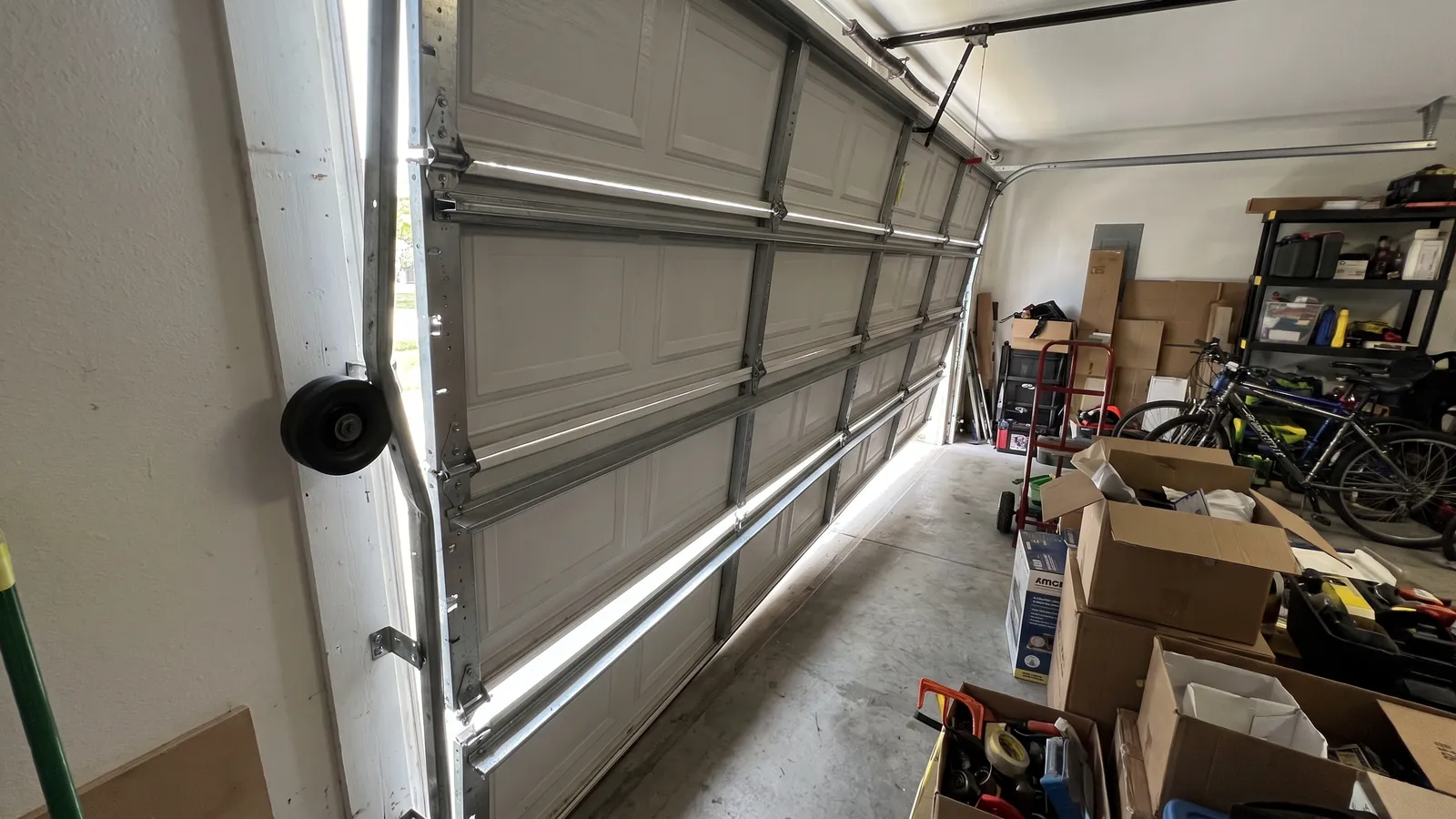
A cable off the drum is why the door is hanging at an angle
Lift cables are the quiet part of the system: two lengths of steel wire running from the bottom bracket of the door up to a grooved drum on the spring shaft. They do nothing dramatic until one frays, slips its groove or snaps, at which point the door immediately stops being level.
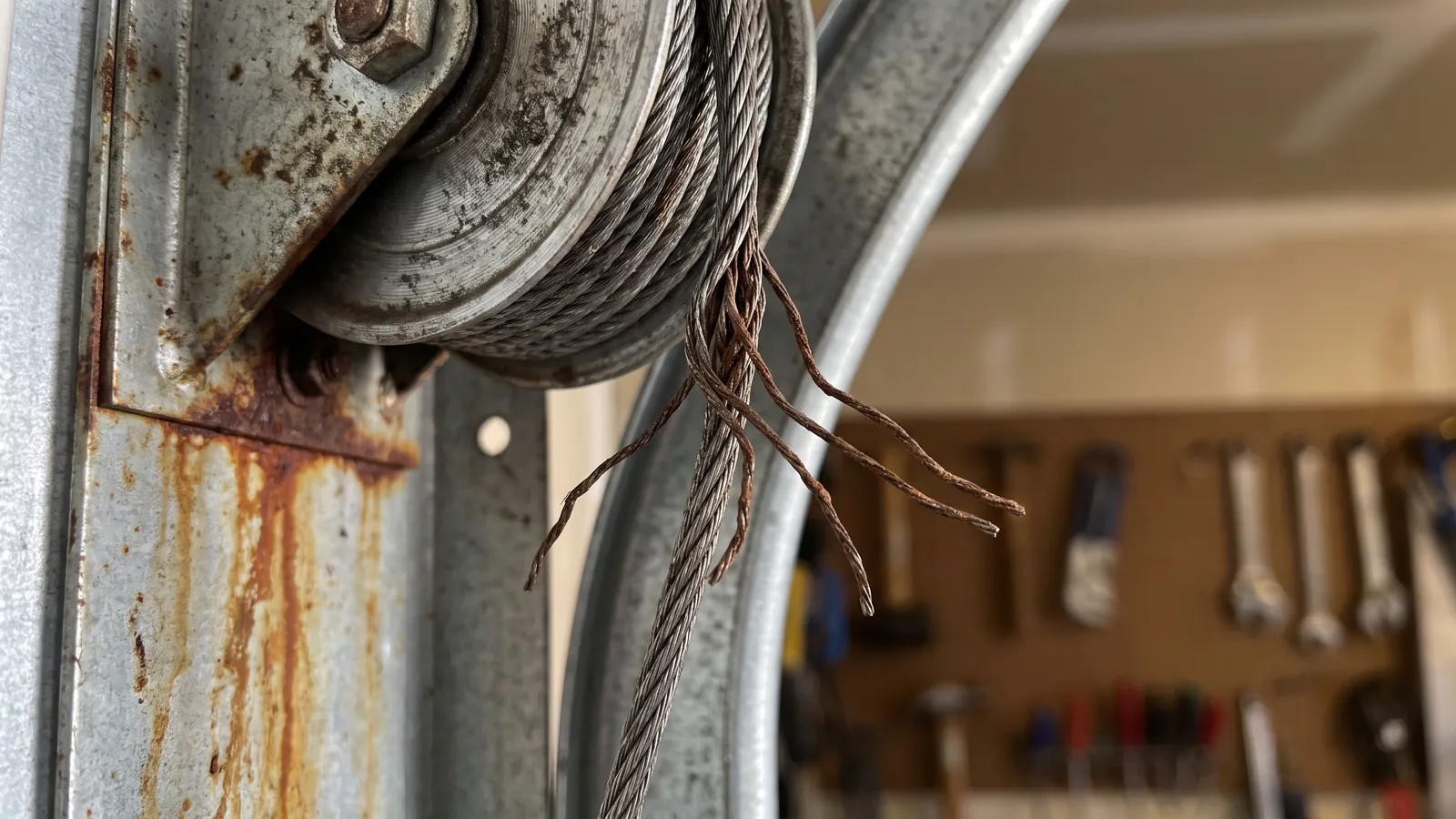
The classic symptom is a door hanging crooked, higher on one side than the other, with a visible loop of slack cable somewhere near the top corner. Sometimes the cable has unwound from the drum entirely and is lying coiled on the garage floor. Sometimes it has snapped and the door has jammed itself in the rail at an angle. In all of these cases the sensible move is to stop using the door — every further attempt to run it drives the rollers harder into the rail and turns a cable job into a cable-and-rail job.
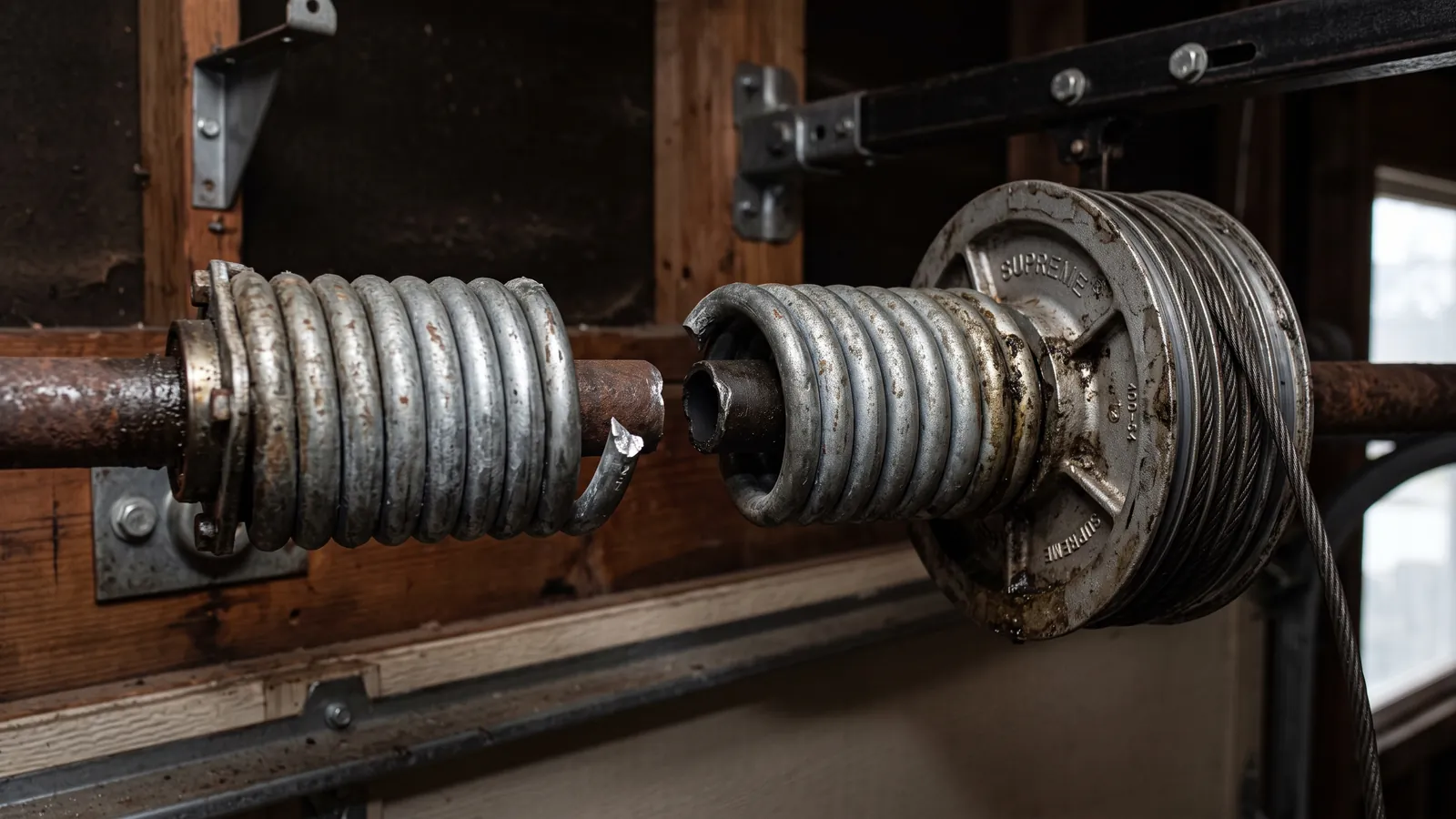
Cables fail for three reasons here, and two of them are specific to this climate. The first is simple age and cycles: steel wire fatigues where it bends around the drum and at the bottom bracket. The second is corrosion at the bottom — the bottom foot of each cable sits closest to a slab that is wet with snowmelt and road salt through the winter, and salt-laden water wicks into the strands. Cables almost always fray from the bottom up for this reason, and a cable that looks pristine at eye level can be half gone at the bracket. The third is a spring failure that took the cable with it; when a spring lets go, the sudden slack lets a cable jump its groove, which is why we check both whenever we replace a spring.
There is also the impact case: somebody reverses into the door, or a bin is left in the opening and the door closes onto it. The door racks, a roller pops, a cable goes slack and unwinds. That is an off-track repair with a cable job inside it.
Cables are replaced in pairs, always. They are cheap, they have aged identically, and the labour to do the second one while the first is being done is almost nothing — whereas coming back for the survivor costs a whole visit. While the shaft is accessible the drums are checked for wear in the grooves and re-seated so both cables wind evenly, which is what stops the door rising crooked afterwards. The bottom brackets get a look too, because a corroded bracket is the thing that fails next and it is under tension from the cable it holds.
What's included
Replaced as a pair
Both cables are the same age and have the same corrosion exposure. Doing one and leaving the other buys a second call-out.
Drums checked and re-seated
Worn or slipped drums are why a door rises crooked and why one cable frays long before its twin.
Bottom brackets inspected
The bracket at the foot of the door is under cable tension and takes the worst of the salt and meltwater.
Wound to even tension
Both cables set so the door lifts level, then tested through the full travel before the opener goes back on.
Rail and rollers checked
A cable failure usually means the door has run at an angle, so the rollers and rail get a look before it is used again.
Same-day stock
Cables and drums for the common residential door sizes are carried on the truck.
Cable repair prices on the Kansas side
| Job | Typical price | Notes |
|---|---|---|
| Lift cables, pair | $140 – $270 | Fitted, wound and balanced |
| Cables with drums | $240 – $420 | When the drum grooves are worn or a drum has slipped |
| Cable off the drum, rewound | $120 – $230 | No parts needed if the cable is sound |
| Cables plus bottom brackets | $230 – $400 | Common on doors with salt corrosion at the foot |
| Cable and spring together | $395 – $650 | The usual pairing after a spring failure |
| Cable with off-track reset | $260 – $520 | When the door has jammed in the rail |
| Commercial or high-lift cables | $280 – $560 | Longer runs and heavier wire |
| Safety containment cables | $95 – $180 | For older extension-spring doors without them |
These are 2026 ranges for the Kansas side of the metro, to give you a figure to plan around. What you pay is agreed in the driveway before work starts, with parts and labour listed separately; new doors and openers get a written figure that holds for 30 days.
Recent work
Questions we get about cable repair
Can I keep using the door until you get here?
No, and this is the one where we are firm about it. A door running on one cable loads everything unevenly — it drives rollers into the rail, bends the rail, and can drop the door at an angle. Leave it where it is, park outside if you can, and we will get to you the same day.
How do I know whether a cable is worn?
Run a gloved hand along the bottom two feet — never a bare hand, because frayed wire is vicious. Broken strands feel like whiskers. Look for rust staining, for kinks, and for any flattening where the cable has been crushed. Because cables corrode from the bottom, the part you can see easily at head height tells you very little.
Why do cables rust so badly at the bottom?
Because that is where the water is. Snow comes in on the car, melts on the slab, and carries road salt with it. The bottom foot of each cable and the bottom brackets sit in that for months. It is the single most predictable corrosion point on a garage door in this climate, and it is why we always look there even when the call was about something else.
Do both cables really need doing?
Yes, in practice. They went on together, have run the same number of cycles and sat in the same wet. Replacing one and leaving its twin means the labour and the call-out get paid twice within a year or so. Cables are among the cheapest parts on the door; the visit is the expensive bit.
The door is rising crooked but no cable looks broken. What is that?
Almost always a drum that has slipped on the shaft or a cable that has jumped a groove, so one side is winding more than the other. It is a quick fix if it is caught early. Left alone, the cable that is doing extra work frays, and then you have the full job.
Did my cable snap because the spring broke, or the other way round?
Usually the spring first. When a spring lets go, the door drops and the sudden slack lets a cable jump off its drum or snatch hard enough to fail. That is why a spring replacement always includes a cable inspection — fitting a new spring to a damaged cable just means we are both back here next month.