The door starts down, thinks better of it, and goes straight back up
Two small photo eyes face each other a few inches above the floor on either side of the opening. If the beam between them is broken — or if either eye merely believes it is — the opener refuses to close the door. In a cold garage, believing it is the usual problem.
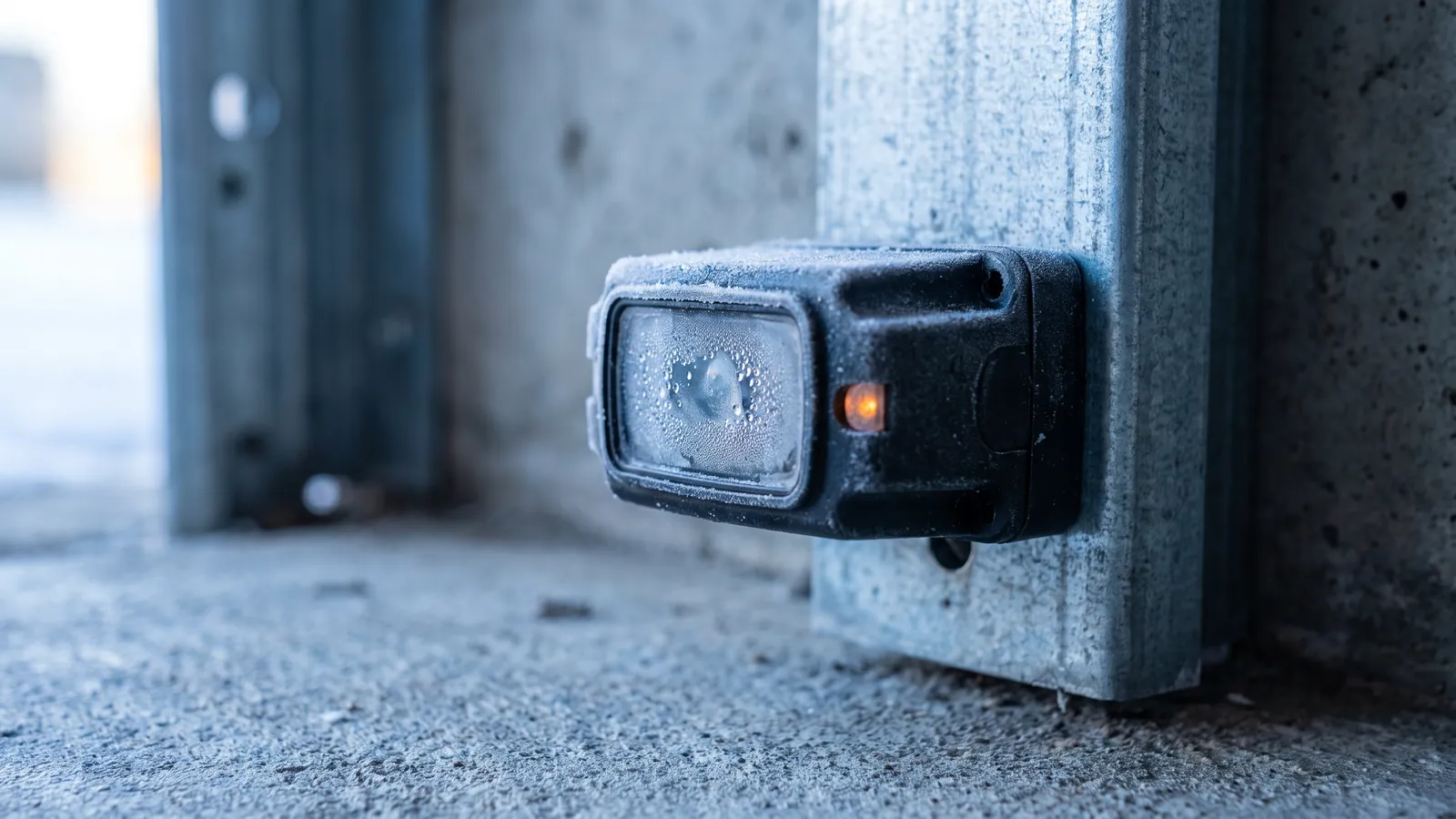
Photo eyes have been required on every opener sold in the United States since 1993, and they are the reason a garage door no longer closes on things. The system is deliberately unforgiving: any doubt and the door goes back up. That is correct behaviour, and it is also why a fault here is so visible — you lose the ability to close the door at all from the remote.
Alignment is the first suspect. The brackets are soft metal and sit at ankle height, so a bike pedal, a bin, a snow shovel or a foot knocks them out of true. Both eyes have indicator lights; the exact convention varies by brand, but the principle is the same — a steady light on both means they can see each other, and a flickering or extinguished light means they cannot. Nudging one until the light settles is a genuinely reasonable thing to try yourself before calling anyone.
Condensation and frost are the ones particular to this climate, and they catch people out because the fault comes and goes. A car driven in off a cold road into a closed garage puts a surprising amount of moisture into the air, and it settles on the first cold surface it finds — including a sensor lens three inches off a concrete slab. A lens with a film of moisture on it, or a rime of frost on a really cold morning, passes less light and the opener reads that as an obstruction. The door then misbehaves at seven in the morning and works perfectly at lunchtime, which is why people assume the opener is going. Wiping both lenses with a dry cloth fixes it that day; if it keeps happening, the eyes may be mounted lower than they need to be, and raising them slightly within the permitted height helps.
Wiring is the third cause and the most likely to need a visit. The two-core wire running from each eye back to the motor is usually stapled along the framing, and over twenty years staples cut into insulation, mice take an interest, and a strimmer or a shelf bracket finds the run. A sensor with a damaged wire behaves erratically — fine for days, then dead — which is the hardest version to diagnose from the sofa and the easiest with a meter.
And sometimes the eyes are innocent. If both indicators are steady and the door still reverses, the fault has moved to the travel limits or the force setting: the opener is meeting resistance on the way down, deciding it has hit something, and reversing as designed. That points at the door rather than the sensors — a stiff rail, a dry roller, or a seal frozen to the slab.
What's included
Alignment set properly
Both eyes squared to each other and locked in brackets that will hold, not nudged and hoped for.
Lenses cleaned and assessed
Condensation, frost and years of dust dealt with, and the mounting height reviewed if moisture keeps returning.
Wiring traced end to end
Staple damage, rodent damage and breaks found with a meter instead of by swapping parts.
Eyes replaced where needed
Matched to the opener; mismatched aftermarket pairs are a common cause of intermittent faults.
Limits and force checked too
Because a reversing door with healthy sensors is a travel or resistance problem, not a sensor problem.
Obstruction test before leaving
The door must reverse on contact. That test is the whole point of the system and it gets done every visit.
Safety sensor repair prices on the Kansas side
| Job | Typical price | Notes |
|---|---|---|
| Sensor alignment and clean | $75 – $140 | Where the eyes and wiring are sound |
| Safety sensors, pair | $100 – $200 | Supplied, fitted and aligned |
| Sensor wiring repair | $95 – $210 | Staple, rodent or impact damage |
| Full rewire of a sensor run | $160 – $310 | Where the original cable is beyond patching |
| Bracket replacement | $55 – $110 | For brackets bent beyond adjustment |
| Travel and force recalibration | $85 – $160 | When the sensors turn out to be innocent |
| Raised sensor remount | $90 – $170 | Helps where condensation is a recurring problem |
| Diagnosis | $69 – $119 | Waived when the repair goes ahead |
These are 2026 ranges for the Kansas side of the metro, to give you a figure to plan around. What you pay is agreed in the driveway before work starts, with parts and labour listed separately; new doors and openers get a written figure that holds for 30 days.
Recent work
Questions we get about safety sensor repair
Can I fix the alignment myself?
Often, yes, and it is worth five minutes before you call. Look at the little light on each eye. Loosen the wing nut or bracket screw on the one that is dark or flickering, move it slowly until the light goes steady, and tighten it again. Wipe both lenses with a dry cloth while you are down there. That solves a good share of these.
Why does it only happen in the morning?
Condensation. A cold garage, a warm car brought in, and moisture settles on the coldest surfaces overnight — which includes the sensor lenses three inches off the slab. By midday it has evaporated and the door behaves perfectly. It is the single most common winter sensor call we take, and a dry cloth is the cure.
Can I just disconnect the sensors?
No. They have been mandatory on American openers since 1993 because of children and pets killed by closing doors, and an opener with the sensors bypassed will close on anything. If yours are so troublesome that you have been tempted, the answer is to fix or replace them — it is a cheap job and we would far rather do it than hear why you disconnected them.
I replaced the sensors and it still will not close. Now what?
Three possibilities. The replacements may not be matched to your opener — mismatched aftermarket pairs cause exactly this. The wiring may be damaged somewhere along the run, which new eyes will not fix. Or the sensors were never the fault and the opener is reversing because the door is binding on the way down. A meter and five minutes sorts out which.
How high should the sensors be?
Low, by design — around four to six inches above the floor, so that a child or a pet breaks the beam. Mounting them higher to dodge a puddle or a moisture problem defeats the purpose and is not something we will do beyond the small adjustment that still keeps them inside their intended range.
The lights are both steady but the door still reverses. Why?
Then it is not the sensors. The opener is meeting resistance on the way down and reversing as it should. Look for a seal frozen to the slab, a dry or seized roller, a rail that has shifted, or a force setting that drifted. The fix is on the door rather than the eyes, and we check the whole travel by hand to find it.